
Dealership vs. Specialist Finance Broker: How to Avoid the Captive Finance Trap
Whether you are stepping into a sleek flagship showroom or browsing a high-volume pre-owned car superstore, the process of buying a vehicle is engineered to captivate. Modern car dealerships have perfected the art of presentation—complimentary coffee, energetic sales floors, and pristine vehicle detailing give even used cars a brand-new allure.
Yet beneath the polished exterior lies a major financial vulnerability for consumers: point-of-sale (POS) finance. Convenient as it seems to drive away with loan paperwork signed on the spot, combining the asset sale with credit origination creates a structural conflict of interest that costs buyers thousands globally.
The Conflict of Interest at the Dealership Desk
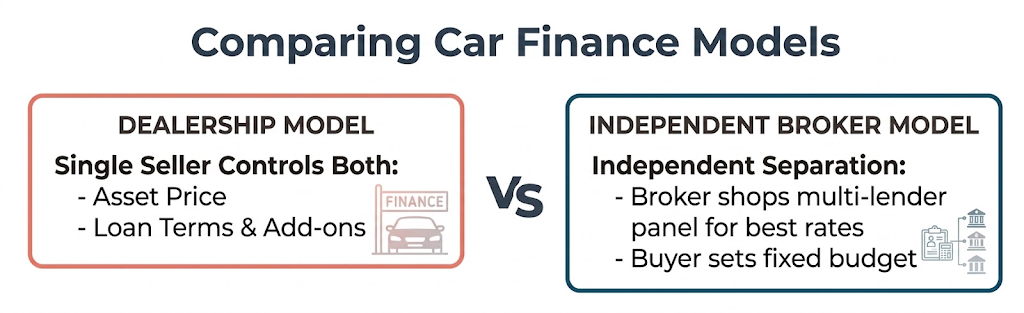
When a seller provides both the asset (the car) and the funding (the loan), a structural conflict of interest inevitably arises. Dealerships rarely act as neutral credit facilitators. Instead, point-of-sale finance departments operate as significant profit centers.
When a single commercial entity controls both the retail price and the credit terms, cross-subsidisation can occur:
- A seemingly discounted vehicle price may be offset by inflated interest rates or add-on products.
- Certain insurances, warranties, and vehicle protection packages can more easily be incorporated in a monthly payment.
When the seller benefits from maximising both the vehicle price and the finance package, objective financial advice for the buyer can be diluted.
Each phase introduces distinct credit mechanics, risk metrics, and underwriting parameters. Treating these unique transaction profiles with a single, generalist broking approach can compromises structural flexibility and increase the cost of capital.
Global Regulatory Protections: Diluting the Point-of-Sale “Dopamine Rush”
Point-of-sale vehicle finance is a multi-billion-dollar global industry, and financial regulators worldwide have increasingly recognised how high-pressure environments exploit consumer impulse. To protect buyers from loaded financial deals, various jurisdictions including Australia, have introduced structural “circuit breakers” and regulatory safeguards.
As an example, under the UK Consumer Credit Act, and the UK Credit Directive, consumers hold a statutory 14-day right of withdrawal from credit agreements, without giving any reason. This mandatory pause creates a cooling-off window, allowing buyers to cancel unwanted dealership loans after the initial emotional rush of the car purchase wears off.
Similar to the UK, Australia has banned ‘flex’ commissions to reduce a dealer’s ability to arbitrarily alter interest rates.
Still, the beneficial effectiveness of such provisions can be questioned.
A Cautionary Tale: High-Pressure Captive Finance
The risks inherent in point-of-sale finance environments were highlighted when used car dealership chain OzCar recently entered administration. Four corporate-owned stores were closed and 90 workers were laid off following maximum financial penalties imposed by NSW Fair Trading for fair-trading breaches.
Regulators cited systemic high-pressure sales tactics, unfair contractual practices, and the erosion of statutory consumer protections. When profit margins depend heavily on closing finance and add-on sales on the spot, consumer interests are often sidelined. The extent that finance revenues propped up the group’s financial position is unknown.
Regulatory authorities underscored pervasive high-pressure sales methodologies, inequitable contractual terms, and the systematic compromise of statutory consumer safeguards. Where corporate profitability hinges overwhelmingly on immediate point-of-sale credit origination and secondary product markups, consumer welfare can be subordinated. The precise degree to which financing revenues artificially buoyed the group’s overall balance sheet remains unquantified.
NOTE: Refer below for reference sites.
The Behavioral Economics: Why the Dopamine Rush Blinds Buyers
You do not need to be buying a brand-new luxury vehicle to experience the neurological high of vehicle acquisition. Behavioral economics shows that purchasing a car triggers a substantial release of dopamine – the neurotransmitter associated with reward, anticipation, and status.
This emotional spike temporarily suppresses activity in the brain’s prefrontal cortex, which handles risk assessment and long-term financial planning. F&I managers routinely exploit this cognitive state using specific behavioral triggers:
- The “Single Monthly Payment” Illusion
Sales staff reframe a vehicle’s cost away from total principal and cumulative interest, anchoring the conversation exclusively around a “manageable” weekly or monthly payment. - Manufactured Urgency
Tactics creating artificial scarcity (e.g., “Another buyer is coming back for this car in an hour”) induce FOMO (Fear Of Missing Out), tempting buyers to finalise finance on the spot rather than shopping around. - Frictionless Add-ons
When committing $35,000 to a car purchase, adding $1,200 for a paint protection package feels trivial – less than the price of a daily coffee – even though financing it adds compound interest for half a decade.
The Specialist Finance Broker Solution
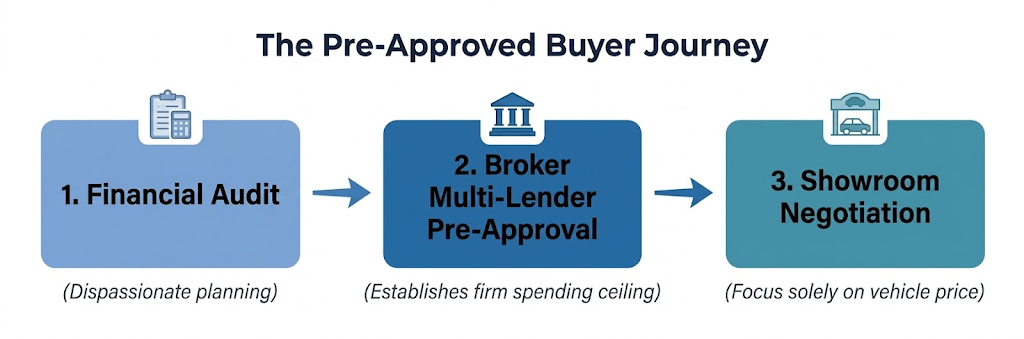
To counteract impulse buying, credit origination must be completely decoupled from vehicle sales. Engaging an independent finance broker before stepping onto a dealership lot creates a natural firewall against emotional decisions.
Request a Leidara Briefing First
Before seeking finance, speak with Leidara.
Speak with a Leidara finance consultant →
External Articles & References
- https://www.asic.gov.au/regulatory-resources/find-a-document/regulatory-guides/rg-275-the-deferred-sales-model-for-add-on-insurance
- https://download.asic.gov.au/media/4422973/cp294-published-24-august-2017.pdf
- https://autotalk.com.au/industry-news/ozcar-enters-administration-closing-four-nsw-sites
- https://www.nsw.gov.au/departments-and-agencies/fair-trading/news/disciplinary-action-taken-against-used-car-dealer-ozcar-for-misleading-consumers-and-unconscionable-conduct
- “How Commercial Finance Brokers Get Paid,” Aurelius Capital, on the scope of the Best Interests Duty and its exclusion of most commercial finance. aureliuscapital.com.au
Disclaimer
This article is for general information only and is not legal or financial advice. Readers should contact Leidara to obtain independent professional advice specific to their situation.