
Navigating Commercial Finance: Bank vs. Private Credit Debt Architectures
Enterprise expansion in Australia requires precise liquidity allocation across the corporate lifecycle. Selecting between a traditional commercial finance bank model and private credit determines your operational flexibility, capital cost, and exposure to institutional risk parameters.
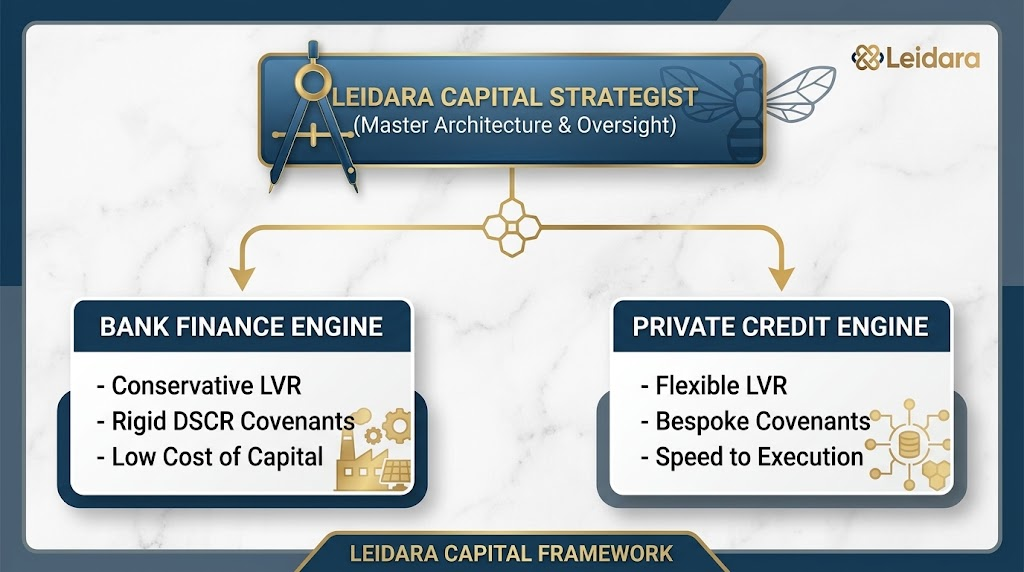
Strategic Blueprint
-
-
Capital Cost Trade-Offs: A traditional commercial finance bank provides lower interest margins, but enforces strict LVR limits and conservative debt service coverage ratios.
-
Execution Speed: Conversely, private credit funds deploy liquidity rapidly, accepting higher risk profiles while requiring tailored loan covenants to safeguard investor capital.
-
Architectural Coordination: Leidara connects enterprise owners with specialist brokers to engineer balanced capital stacks without compromising operational flexibility or triggering default covenants.
-
Macro and Microeconomic Dynamics in Australia
At the macro level, systemic liquidity shifts dictate how institutional lenders allocate capital across commercial sectors. Specifically, changing cash rates alter corporate borrowing power, forcing lenders to adjust their bank risk management frameworks.
Consequently, bankable companies face tighter underwriting parameters during monetary contraction phases. These broader economic forces ripple down directly to the micro level of your business operations.
Microeconomically, a company’s immediate balance sheet strength dictates its available funding pathways. Therefore, businesses with strong cash flow metrics can secure lower margins, whereas capital-intensive businesses often look beyond traditional lenders to maintain momentum.
Evaluating Commercial Finance Bank Facilities
Traditional banking institutions remain the primary source of low-cost capital for established Australian enterprises. However, securing a traditional commercial loan requires passing stringent risk assessments and proving continuous cash flow stability.
Positives of Bank Debt Architecture
-
Minimal Cost of Capital: Traditional banks offer the lowest base interest rates and tightest margins across the capital spectrum.
-
Long-Term Amortization: Facilities typically support multi-year terms, providing predictable debt service schedules for stable enterprises.
-
Institutional Stability: Established banks offer secure clearing facilities, treasury services, and standardized operational workflows.
Negatives of Bank Debt Architecture
-
Rigid Covenants: Banks enforce strict loan covenants, including tight debt service coverage ratio (DSCR) thresholds that limit operational breathing room.
-
Conservative LVR Limits: Traditional underwriting caps the maximum LVR, forcing enterprise owners to commit substantial equity up front.
-
Slow Settlement Timelines: Exhaustive credit committees often delay capital deployment, causing missed acquisition or expansion opportunities.
Evaluating Private Credit Alternatives
The expansion of non-bank lending has created flexible alternatives to standard institutional debt. As a result, non-bank lenders now fund complex transactions that fall outside traditional risk parameters.
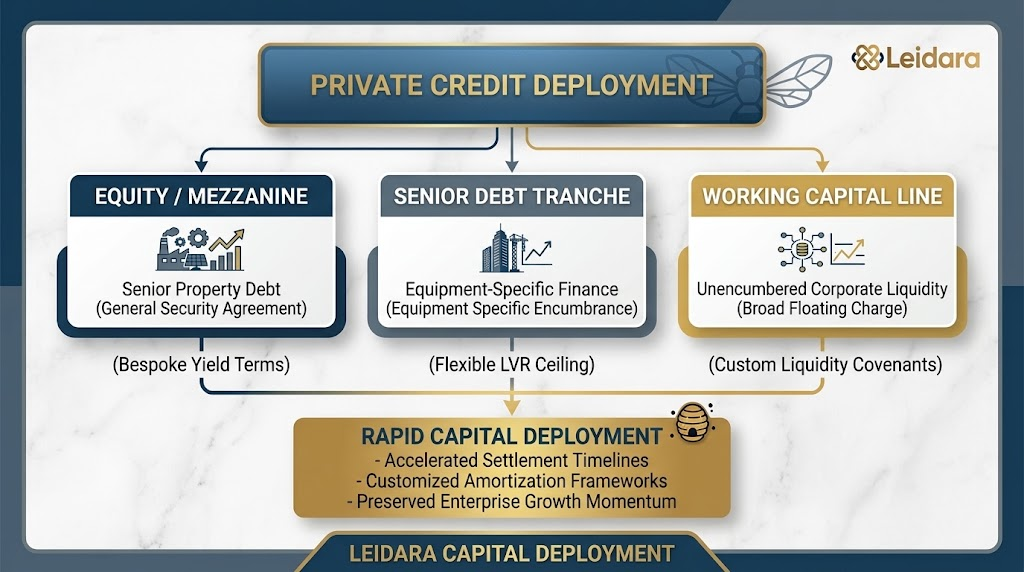
Positives of Private Credit Architecture
-
Rapid Execution: Non-bank funders evaluate and deploy capital quickly, allowing businesses to capitalize on immediate growth mandates.
-
Structural Flexibility: Terms feature tailored repayment frameworks, specialized interest capitalization, and customized loan covenants.
-
Higher LVR Thresholds: Lenders accept higher leverage, reducing the upfront equity required for major capital projects.
Negatives of Private Credit Architecture
-
Elevated Margin Costs: Non-bank capital carries higher interest rates to compensate for elevated risk exposure.
-
Shorter Term Maturities: Facilities typically feature short-term horizons, creating refinance exposure if market conditions shift.
-
Complex Yield Requirements: Fee structures often include exit fees, minimum return hurdles, and performance-based interest adjustments.
Structural Comparison: Commercial Finance Bank vs. Private Credit
Choosing the wrong funding vehicle creates friction across your balance sheet. The table below outlines how these two capital sources perform across critical financial metrics.
| Structural Metric | Commercial Finance Bank | Private Credit Fund |
|---|---|---|
| Execution Speed | Slow (6–12 weeks) | Fast (1–3 weeks) |
| Underwriting Focus | Historical profit ratios & cash flow | Asset backing & exit strategy |
| Covenant Rigidity | High (strict quarterly checks) | Flexible (tailored to enterprise milestones) |
| Leverage Limits | Conservative LVR caps | Higher LVR capacity |
Emerging Financial Trends Impacting Enterprise Borrowers
Evolving regulatory requirements continue to shape how Australian institutions manage credit risk. Specifically, Australian Prudential Regulation Authority (APRA) guidelines drive stricter stress-testing models across traditional institutions.
Consequently, mid-market businesses must continually monitor key profit ratios to maintain their bankable status. If debt service capabilities soften, traditional lenders often attempt to reduce their exposure quickly.
Therefore, forward-thinking enterprises build flexible capital stacks combining both senior bank debt and subordinated non-bank facilities. This dual approach optimizes the total cost of capital while preserving operational liquidity.
The Leidara Model for Commercial Finance Bank and Private Credit Execution
Navigating the choice between a traditional commercial finance bank and private credit requires deep technical expertise. Leidara acts as your master commercial finance strategist, ensuring your business deploys the exact finance mind required for each mandate.
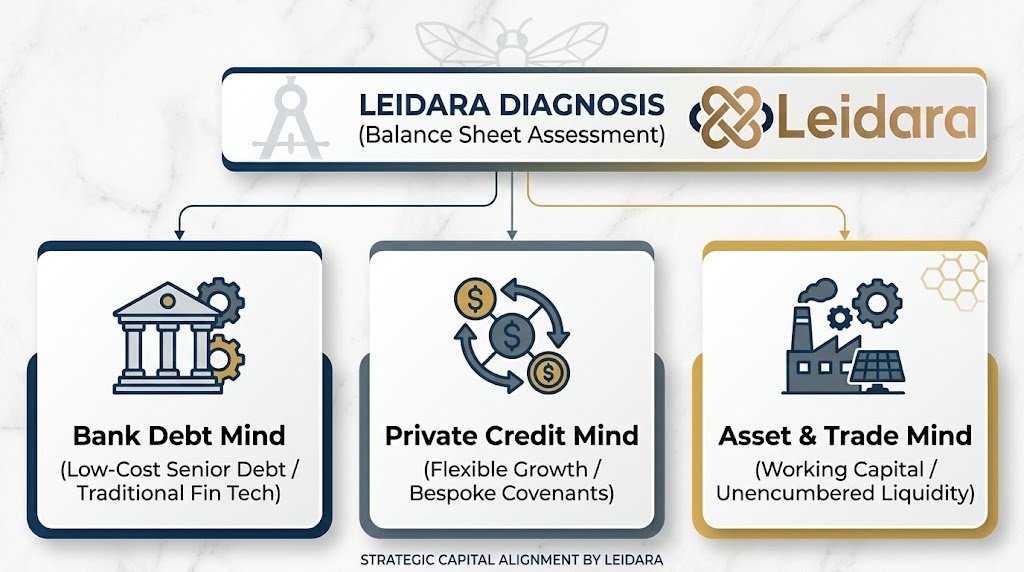
Specifically, Leidara analyses your balance sheet structure before any funder approaches your business. Consequently, we ring-fence company assets, prevent conflicting security charges, and align loan maturity timelines.
Furthermore, Leidara matches your specific mandate with vetted, sector-specific specialist brokers. This ensures your transaction is executed by a domain expert with direct credit committee access.
Optimising Commercial Finance Bank Strategy with Leidara
Achieving sustained commercial growth requires matching the right capital structure to your specific operational goals. By partnering with Leidara, your enterprise secures specialized broker expertise backed by centralized strategic coordination.
To review your upcoming capital requirements or optimize your existing debt structure, submit a complex scenario for review or schedule a private strategic briefing with Leidara’s principal advisers.
The Leidara Execution
Achieving optimal debt execution requires both architectural strategy and precise technical competency. By partnering with Leidara, your enterprise secures targeted domain expertise for every distinct transaction while maintaining a future-proofed capital structure built for long-term dominance.
Connect to strategically architect your enterprise for its next evolutionary phase. Submit a complex scenario for review or schedule a private strategic briefing with Leidara’s principal advisers.
Articles from our Catalogue
External Articles & References
- Mortgage & Finance Association of Australia (MFAA), Industry Intelligence Service data, reported in “Brokers’ market share hits record high: MFAA,” Australian Broker News, 2025. brokernews.com.au
- “How Commercial Finance Brokers Get Paid,” Aurelius Capital, on the scope of the Best Interests Duty and its exclusion of most commercial finance. aureliuscapital.com.au
- ASIC, Regulatory Guide 273: Mortgage brokers — Best interests duty. asic.gov.au
- “Australia’s Watchdog Uncovers Risks in Private Credit Probe,” Bloomberg, 4 November 2025. bloomberg.com
- Reserve Bank of Australia, “Small Business Economic and Financial Conditions,” RBA Bulletin, October 2025. rba.gov.au
Disclaimer
This article is for general information only and is not legal or financial advice. Business owners should contact Leidara to obtain independent professional advice specific to their situation.